Pascale Vayer
02 October 2026
I am deeply moved.
Yesterday we sent the Christmas Angel campaign to the contacts of kleine herzen sent. Just 16 hours later, they had already More than 100 children found their Christmas angel.
From the bottom of my heart: Thank you! In a world marked by war, suffering, and bad news, you remind us that there is another force: solidarity. Thanks to you, more than 100 children will receive not only a gift, but also a sign of hope.
You are proof that humanity is stronger than hate. Thank you for giving hope.
September 24, 2026
I have just received the first list of children who will be supported by the project.
When I read about her family situation, I couldn't hide my concern. Despite all the years I've spent helping children affected by poverty and war, I thought I'd learned to maintain some distance.
But how can one remain unmoved when reading: displaced child, orphan, child whose father is fighting at the front, child who has lost a loved one to the war?
Behind each of these labels is a real child with their fears, their hurts, but also their hopes.
These few lines have reminded me once again why we are committed to helping these children.
September 23, 2026
Every year, as Christmas approaches, I ask myself the same question: How can you bring a little joy to a child growing up in the middle of war?
For more than four years, the war in Ukraine has shaped the lives of millions of children. Many have lost their homes, had to flee, live near the front lines, or have lost a parent.
Faced with this reality, one sometimes feels powerless. It was precisely out of this feeling that I, together with our Ukrainian partners, SaveUkraine and Caritas-Spes Ukraine The Christmas Angels project was launched for children suffering from the effects of the war in Ukraine.
Our goal is simple: to bring joy and hope to children in war zones this Christmas. Because every gift carries the same message: "You are not forgotten. Someone is thinking of you."
Since the beginning of summer, we have been preparing this project together with our partners in Ukraine. Behind every child is a story, behind every gift are dedicated people who refuse to look away.
In this blog, I'll take you behind the scenes of Christmas Angels. I'll show you how the project works, what challenges we face in Ukraine, and why hope remains possible even in the darkest times.
Because despite war, fear, and uncertainty, children continue to dream of a better future. Together, we can show them that they are not alone.
The principle behind the project is extremely simple.
We invite individuals, families and companies to become a Ukrainian child's "Christmas angel" and to fund the gift that the child has chosen.
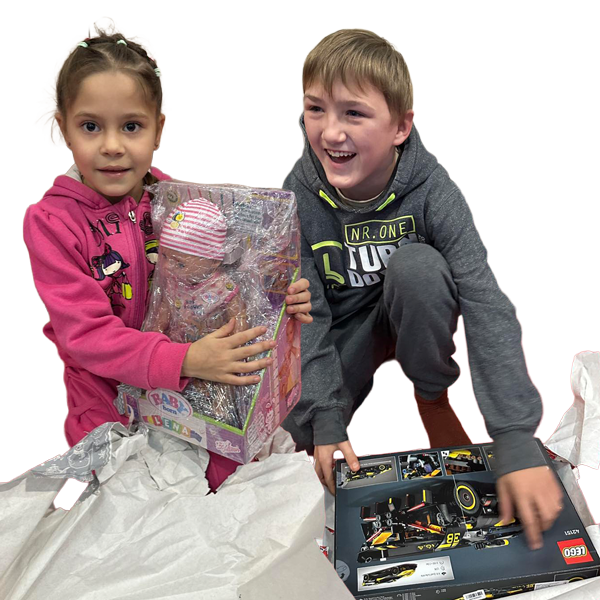
It's not a gift chosen by an adult. It's the child's personal wish. A doll. A soccer ball. A LEGO set. A book. Headphones. A box of colored pencils.
Things that may seem obvious to many of us, but often represent a long-cherished dream for these children.
Because when everything seems to be lost, the possibility of choosing something for oneself means infinitely much.
Many people believe that a project of this size would be carried out by a large organization with extensive resources. The reality is considerably more modest.
A large part of the coordination lies directly with me, supported by our Ukrainian partner organizations.
I seek sponsors among companies, foundations, and private individuals. I create project documentation, coordinate communication, monitor donations, and ensure that every child finds a sponsor. My goal is simple:
Not a single child in the project should be forgotten.
Every year this means hundreds of hours of work, but also many moving encounters with people who want to help in a concrete way.


While I coordinate the project from Austria, the most difficult work is being done in Ukraine.
Our partners Save Ukraine and Caritas-Spes Ukraine stand by the side of children and families affected by the war every day. They organize psychosocial support programs, accompany displaced families, support traumatized children, and often work in regions near the combat zones.
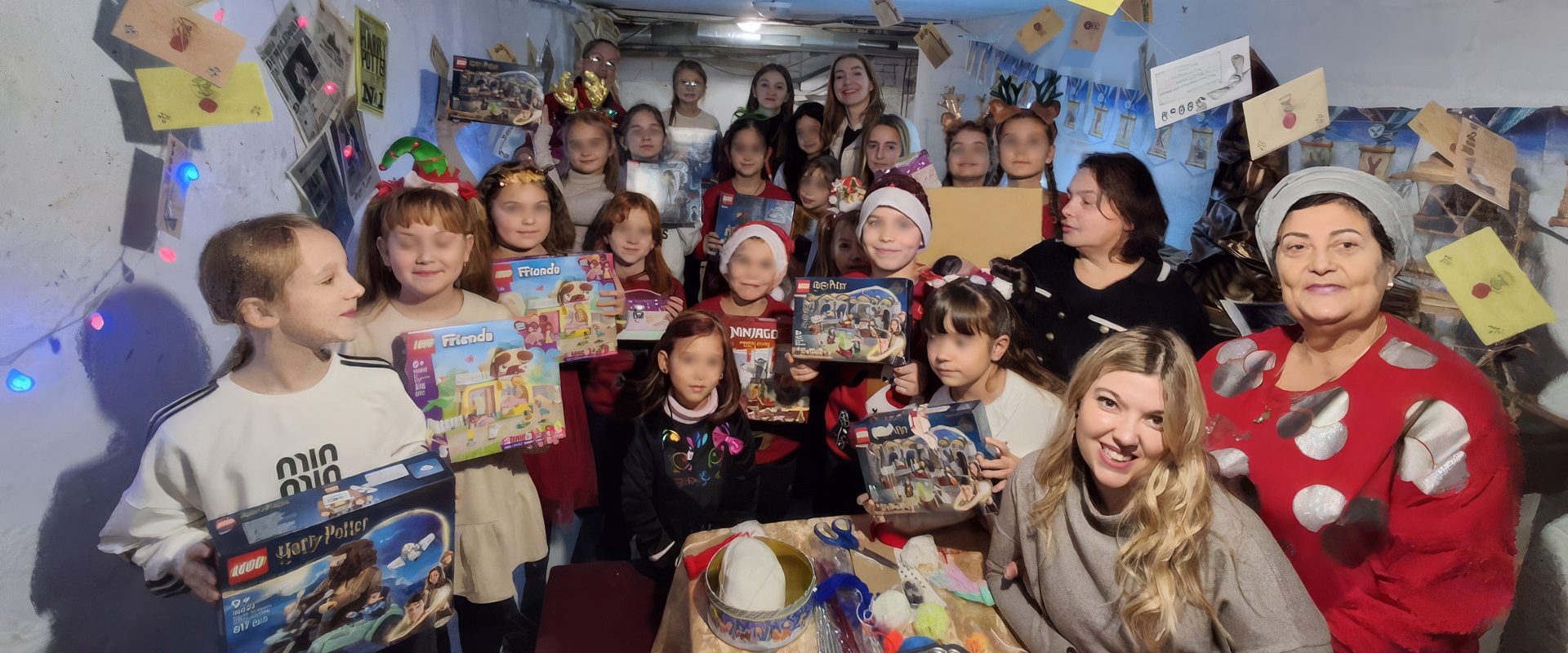
They are the ones who select the participating children. They create the gift catalog. They buy the gifts, wrap them lovingly, and deliver them personally.
They organize Christmas parties in their centers or, if bombing raids take place, in air-raid shelters, giving the children a few hours in which they can simply be children.
Their courage and commitment impress me more and more each year.
Organizing a Christmas project in a war zone presents countless challenges. For people in Western Europe, it is often difficult to imagine the obstacles our partners face. The war affects every single phase of the project.
A region can suddenly become inaccessible. Bombings can disrupt transport. Families are forced to flee again. Certain gifts are suddenly unavailable. Rehabilitation centers must be evacuated. In some cases, a child has already left the region by the time the gifts are distributed.
The war creates constant uncertainty that we must consider in every step of the project. Nothing is ever completely predictable. Our partners consistently demonstrate exceptional creativity and adaptability.
If a gift cannot be obtained, an equivalent replacement will be found. If a family has to move, our partners will try to find the child again or give the gift to another child in a similar situation.
Some people ask me if a Christmas present can make any difference in the face of the horrors of war. Of course, a present won't end the war. It won't rebuild a destroyed house. It won't heal trauma. But it can teach a child something crucial: Someone is thinking of me.
Somewhere in Europe, someone decided that my life matters and that I must not be forgotten. For a child living in war, this message is invaluable. Psychologists who work with these children constantly remind us how important gestures of solidarity, attention, and positive experiences are for the healing process.
The gift itself is ultimately just a symbol. What we truly give are moments of joy, hope, and normalcy.
Over the years, the Christmas Angel project has become much more than a fundraising campaign. It is a movement of solidarity that connects people of different backgrounds, languages, and walks of life.
Employees of companies, pensioners, families, students, foundations and volunteers are working together to send a simple message to children in an uncertain world:
This message motivates me to continue the project year after year.
Thanks to the generosity of private sponsors, companies, and foundations, 855 war-affected Ukrainian children received a personal Christmas gift last year. This initiative was even covered by the Austrian television broadcaster ORF and presented to a wide audience.
And only thanks to the support of our partners, volunteers and donors can this human adventure continue.
When I think of Christmas angels, I don't think of presents first.
I'm thinking of the little girl who is getting a doll for the first time in years.
I am thinking of the boy who lives in a rehabilitation center after fleeing the fighting.
I am thinking of all those families who are trying to lead a normal life again despite the war.
As long as this war continues, we will support these children. Because no child should grow up in fear. No child should be forgotten at Christmas. And sometimes a small gesture can give immeasurable hope.
To all the people who support this project, I would simply like to say:
Thank you for bringing a smile back to a child's face.
Thank you for turning a simple gift into a message of hope.
Thank you for becoming a Christmas angel in your own way.
Today, around 600 Ukrainian children are still waiting for their Christmas angel. With €40, you can give a child the gift they've chosen themselves and show them that people believe in them and are thinking about their future. Your support goes beyond simply funding a gift.
They are sending a message of hope, solidarity and humanity to a child who desperately needs this message.


